All managers develop certain styles of leading and motivating their subordinates. “A leadership style therefore can be defined as a pattern of behavior designed to integrate organizational and personnel interests in pursuit of some common objectives”. Generally the managers choose those styles of leadership that are absolutely appropriate to personal, subordinate, and organizational needs. One of the commonly known frameworks contains a trouble free continuum from total autocracy to almost total democracy. This continuum would consist of coercive autocracy, benevolent autocracy, manipulative autocracy, consultative leadership, and a laissez fair approach.
The coercive autocracy indicates the necessary threat of leader or force. The benevolent autocracy comes in, where the leader elucidates, utilizing positive reinforcement if the behavior is accommodating. Thirdly the manipulative autocracy signifies that a leader cons subordinates into thinking. The consultative leadership shows the positive attitude and behavior of the employees that their inputs are truly designed and can have an influence upon the decision. Finally a laissez fair approach represents that the leader wants to join the bunch as a fellow participant and do what the group would actually like to do.
Many scientists and theorists have thoroughly proposed the styles of leadership. Although there are many scientists of leadership styles but the most popular of them would involve Reddin, Fieldler, Vroom and Yetton. Firstly Reddin 3-D theory would include various types of important elements and styles: missionary, upper organizational, bureaucrat, and jobs style. When it comes to Fieldler’s contingency theory, it would include leader-member relations, task structure, and position power of the leader. There are two important leadership styles of Fieldler theory including: a highly score LPC leader (personal relations oriented) and low score LPC leader (more task oriented).
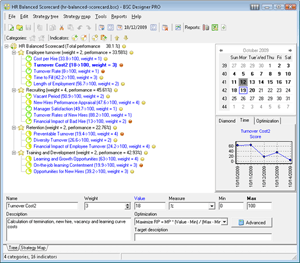
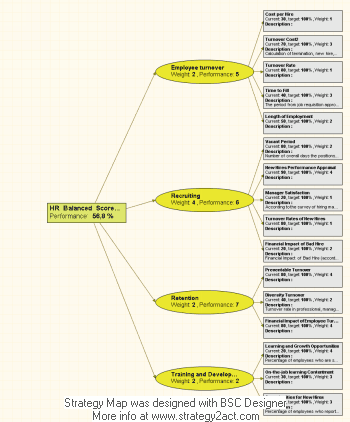
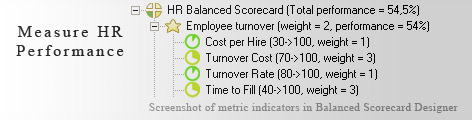
As far as Vroom and Yetton’s decision tree is concerned, it would contain five important leadership styles: decision making, necessary data collection from the subordinates for effective decision making, sharing the problems with relevant subordinates individually, sharing the problem with subordinates as a group for effective decision making, and finally sharing the problem with the chairperson for group consensus. More importantly, the leader will have to regularly utilize certain tools and technologies for evaluating their staff performance. Amongst these tools, HR scorecard metrics would stand apart than all the other methods.
In addition, a leader can employ some other techniques for his organizational output for instance metrics, key performance indicators, training evaluation metrics, balanced scorecard designer, crisis management scorecard, and scoreboards. In short, it can be said that all those leadership styles and approaches are clearly amongst the most cost-effective ways of improving organizational performance worldwide. All you have to do is to fully understand these styles of leadership so that you could be able to accomplish your targets successfully.